
The word antagonistic is used to describe someone or something that is opposing, hostile, unfriendly, or working against another person or thing.
You may see this word when people are arguing, when two groups strongly disagree, or when something actively works against something else.
For example, if someone is constantly rude and hostile toward another person, you might describe their behavior as antagonistic.
In simple words:
Antagonistic means actively opposing, hostile toward, or working against someone or something.
What Does “Antagonistic” Mean?
Antagonistic is an adjective used to describe behavior, attitudes, relationships, or situations involving opposition or hostility.
For example:
“He became antagonistic during the discussion.”
This means he became hostile, argumentative, or openly opposed during the discussion.
The word can describe people, behavior, relationships, groups, or even things that work against each other.
Antagonistic Meaning in Everyday English
In everyday conversation, antagonistic usually describes someone who is unfriendly, confrontational, or deliberately opposed to another person.
For example:
“She was antagonistic toward her coworkers.”
This suggests that she behaved in a hostile or strongly opposing way toward them.
Other examples include:
- “His antagonistic attitude made the meeting difficult.”
- “The two neighbors have an antagonistic relationship.”
- “He sounded antagonistic when I asked him a question.”
The word is generally negative.
Antagonistic Meaning in Relationships
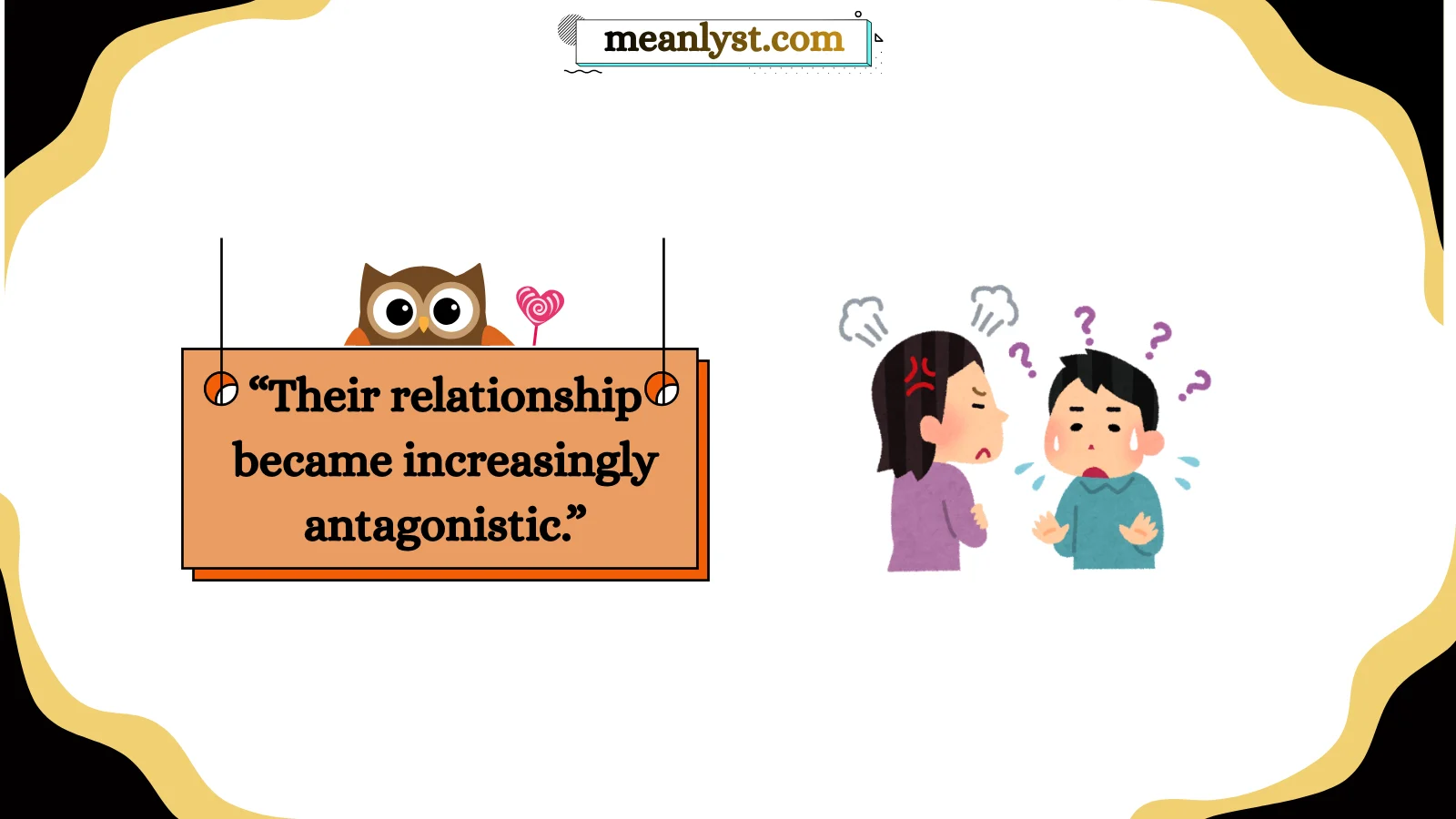
In relationships, antagonistic describes a situation where people regularly behave in a hostile, confrontational, or opposing way toward each other.
For example:
“Their relationship became increasingly antagonistic.”
This means the relationship developed a pattern of conflict, hostility, or opposition.
An antagonistic relationship may involve:
- Frequent arguments
- Hostile comments
- Constant disagreement
- Resentment
- Provoking each other
- Refusing to cooperate
It does not necessarily mean that people openly hate each other. It mainly describes a relationship characterized by opposition or hostility.
Antagonistic Meaning in an Argument
During an argument, someone may become antagonistic if they respond in a hostile or confrontational manner.
For example:
“He became antagonistic when they questioned his decision.”
This means he reacted in an opposing or hostile way.
Someone can disagree with you without being antagonistic. Disagreement is not automatically hostility.
The word usually suggests a stronger or more negative attitude.
Antagonistic vs. Aggressive
These words are related but not identical.
Antagonistic
Means hostile, opposing, or confrontational.
Aggressive
Usually means forceful, threatening, or ready to attack or confront.
For example:
“He was antagonistic toward his opponent.”
This means he was hostile or strongly opposed.
“He became aggressive during the argument.”
This suggests a more forceful or potentially threatening behavior.
A person can be antagonistic without being physically aggressive.
Antagonistic vs. Hostile
Hostile and antagonistic are very similar.
Hostile directly means unfriendly, aggressive, or opposed.
Antagonistic often emphasizes active opposition or conflict.
For example:
“The manager was hostile toward the employee.”
This describes an unfriendly attitude.
“The manager was antagonistic toward the employee.”
This can suggest that the manager was actively opposing or confronting the employee.
In many everyday situations, the words can be used similarly.
Antagonistic Meaning in Literature
In literature, the word can be connected to the idea of an antagonist.
An antagonist is a character or force that opposes the protagonist.
However, antagonistic does not simply mean “the villain.”
An antagonist can be a person, organization, society, nature, or another force that creates opposition for the main character.
For example:
“The character has an antagonistic relationship with the protagonist.”
This means the character is in opposition to the protagonist.
Antagonistic Meaning in Science and Medicine
The word antagonistic can also have a technical meaning.
In science, biology, pharmacology, and medicine, it can describe substances, muscles, processes, or systems that oppose or counteract each other.
For example, an antagonist in pharmacology can be a substance that blocks or reduces the action of another substance, such as a receptor agonist.
The general idea remains the same:
One thing works against another.
Antagonistic Muscles
In anatomy and exercise science, muscles can be described as antagonistic when they perform opposing actions.
For example, the biceps and triceps are commonly described as an antagonistic muscle pair because they perform opposite actions at the elbow.
So in this context, antagonistic does not mean angry or hostile.
It simply means opposing in function.
Antagonistic Meaning in Biology
In biology, two organisms, processes, or biological effects may be described as antagonistic when one counteracts or interferes with the other.
For example:
“The two substances have antagonistic effects.”
This means their effects work against each other.
The scientific use is therefore different from the everyday use, but both meanings are based on the same basic idea of opposition.
Is “Antagonistic” a Slang Word?
No.
Antagonistic is a standard English word, not slang.
It can appear in:
- Everyday conversations
- Academic writing
- Psychology
- Science
- Medicine
- Literature
- News articles
- Workplace communication
It is more formal than simple words such as rude, mean, or hostile.
Antagonistic Meaning in Texting and Social Media
In texting and social media, antagonistic usually keeps its standard meaning.
For example:
“Why are you being so antagonistic?”
This means:
“Why are you being so hostile or confrontational?”
Someone might also describe an online argument as antagonistic when the people involved are constantly attacking or opposing each other.
It is not a special internet slang term.
Synonyms for Antagonistic
Depending on the context, synonyms can include:
- Hostile
- Opposing
- Confrontational
- Unfriendly
- Adversarial
- Combative
- Resistant
- Confronting
- Contentious
- Oppositional
Not every synonym works in every situation. For example, opposing can be neutral in scientific contexts, while hostile usually has a stronger negative meaning.
Antagonistic vs. Opposing
Opposing simply means being against something.
Antagonistic often suggests a stronger sense of hostility or conflict.
For example:
“They have opposing political views.”
This does not necessarily mean they dislike each other.
But:
“They have an antagonistic relationship.”
suggests that their interactions are hostile or confrontational.
Examples of “Antagonistic” in Sentences
Example 1:
“His antagonistic behavior made the conversation uncomfortable.”
Example 2:
“She became antagonistic when her opinion was challenged.”
Example 3:
“The two groups have an antagonistic relationship.”
Example 4:
“Try not to sound antagonistic when giving feedback.”
Example 5:
“The two chemicals have antagonistic effects.”
Example 6:
“The antagonist plays an important role in the story.”
Common Phrases With Antagonistic
“Antagonistic behavior”
Behavior that is hostile, confrontational, or strongly opposed.
“Antagonistic attitude”
A hostile or opposing attitude toward someone or something.
“Antagonistic relationship”
A relationship characterized by conflict or opposition.
“Antagonistic toward someone”
Means behaving in a hostile or opposing way toward that person.
“Antagonistic effect”
A scientific expression describing effects that work against each other.
Common Misunderstandings About “Antagonistic”
Antagonistic Does Not Always Mean Angry
Someone can be antagonistic without shouting or showing obvious anger.
A consistently hostile, confrontational, or opposing attitude can also be antagonistic.
Antagonistic Does Not Always Mean Violent
The word does not automatically imply physical violence.
It can describe verbal hostility, disagreement, or opposition.
Antagonistic Does Not Always Mean “Evil”
A character or person can oppose someone else without being morally evil.
The word primarily describes opposition or hostility.
Antagonistic Has a Neutral Technical Meaning in Science
In science and medicine, antagonistic can describe things that counteract one another without implying anger or hostility.
Frequently Asked Questions
What is the simple meaning of antagonistic?
Antagonistic means hostile, opposing, unfriendly, or working against someone or something.
Is antagonistic a negative word?
Usually, yes, when describing a person’s behavior or attitude. In scientific contexts, however, it can simply mean that two things oppose or counteract each other.
What does antagonistic mean in a relationship?
It describes a relationship in which people are frequently hostile, confrontational, or opposed to each other.
Is antagonistic the same as aggressive?
Not exactly. Antagonistic means hostile or opposing, while aggressive usually suggests stronger forceful, threatening, or attacking behavior.
What is an antagonistic person?
An antagonistic person is someone who tends to behave in a hostile, confrontational, or strongly opposing way toward others.
Is antagonistic a slang word?
No. Antagonistic is a standard English adjective, not slang.
What is the difference between antagonist and antagonistic?
An antagonist is a person or force that opposes another, especially in a story.
Antagonistic is an adjective meaning hostile, opposing, or working against something.
Conclusion
Antagonistic means hostile, opposing, confrontational, or working against someone or something.
In everyday English, it often describes a person’s attitude or behavior. In relationships, it can describe ongoing conflict or hostility.
In literature, it relates to opposition between characters, while in science and medicine, it can describe things that counteract each other.
In simple terms:
Antagonistic = strongly opposed, hostile, or working against something or someone.