
The word frequency is commonly used in everyday English, science, technology, music, and many other areas.
Although its basic meaning is related to how often something happens, the exact meaning can change depending on the context.
For example, you might hear someone say, “The frequency of meetings has increased,” meaning the meetings happen more often.
In physics, frequency describes how many times a wave or vibration occurs within a certain period.
In casual conversation, people may also say that two people are “on the same frequency” to describe having similar thoughts, feelings, or ways of understanding things.
In this article, we’ll explain the frequency meaning in simple English, including its everyday, scientific, social, and conversational uses.
What Does Frequency Mean?
Frequency means how often something happens or how many times something occurs during a particular period of time.
In simple words:
Frequency = how often something happens.
For example:
- If you exercise five times a week, your exercise frequency is five times per week.
- If a bus arrives every 10 minutes, it has a certain frequency of service.
- If someone calls you several times a day, the frequency of their calls is high.
The word can also have a more technical meaning in science and physics, where it refers to the number of cycles or vibrations that happen in a given amount of time.
Frequency Meaning in Everyday English
In everyday conversation, frequency usually refers to how often an event, action, or activity happens.
For example:
“The frequency of his visits has decreased.”
This means he visits less often than before.
Another example:
“We need to increase the frequency of our meetings.”
This means the meetings should happen more often.
Frequency can describe activities such as:
- Meetings
- Phone calls
- Visits
- Exercise
- Travel
- Messages
- Events
- Purchases
- School classes
Example Sentences
- “The frequency of my gym visits is three times a week.”
- “She checks her email with high frequency.”
- “The frequency of the meetings increased this month.”
- “How frequently do you travel?”
The related word frequently means “often.”
Frequency Meaning in Science
In science, frequency describes how many times a repeating event happens during a specific period of time.
This concept is especially important in physics, sound, electricity, and waves.
Frequency is commonly measured in hertz (Hz).
One hertz means one cycle per second.
For example:
- 1 Hz = 1 cycle per second
- 10 Hz = 10 cycles per second
- 100 Hz = 100 cycles per second
The higher the frequency, the more cycles occur in the same amount of time.
Frequency Meaning in Physics
In physics, frequency is the number of complete cycles or vibrations that occur per unit of time.
It is commonly represented by the letter f.
The basic formula is:
Frequency = Number of cycles ÷ Time
For example, if a wave completes 20 cycles in 2 seconds:
Frequency = 20 ÷ 2 = 10 Hz
So, the frequency is 10 hertz.
Frequency is closely related to wavelength and wave speed.
Frequency Meaning in Sound
Frequency is also important when talking about sound.
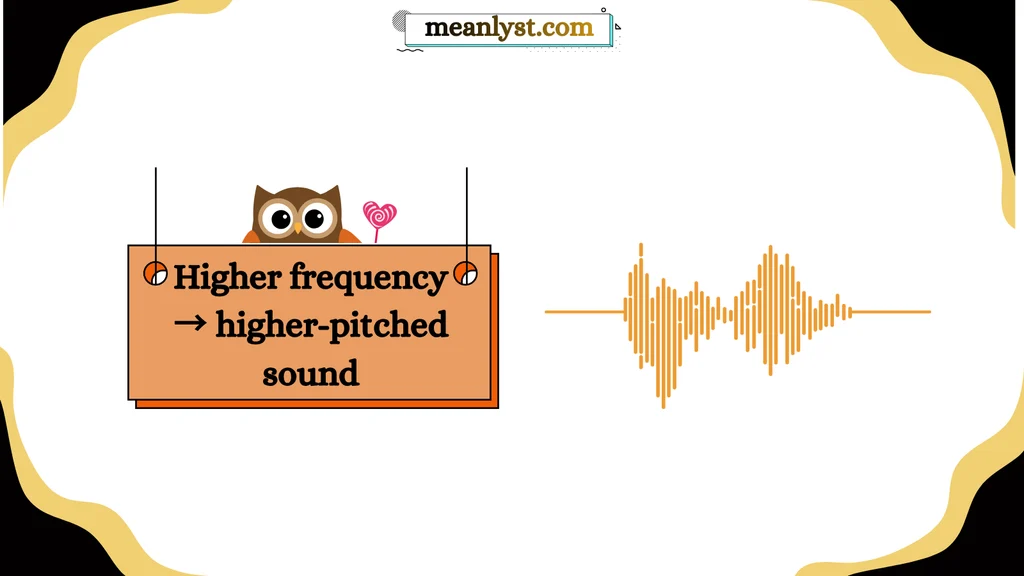
The frequency of a sound wave affects how high or low the sound seems to us.
- Higher frequency → higher-pitched sound
- Lower frequency → lower-pitched sound
For example, a whistle usually produces a higher-pitched sound than a deep bass sound.
This is why frequency is important in:
- Music
- Audio equipment
- Speakers
- Headphones
- Recording
- Acoustics
- Voice analysis
It is important to remember that frequency and volume are not the same thing. Frequency is related to pitch, while loudness is related to the strength or amplitude of the sound wave.
Frequency Meaning in Music
In music and audio, frequency refers to the rate at which a sound wave vibrates.
Different frequencies correspond to different pitches.
For example, bass sounds generally contain lower frequencies, while high musical notes contain higher frequencies.
Audio professionals may talk about:
- Low frequencies
- Mid frequencies
- High frequencies
These categories help describe and adjust different parts of a sound.
Frequency Meaning in Relationships
The word frequency can sometimes be used informally when discussing relationships or communication.
For example:
“We talk with a high frequency.”
This means the people communicate often.
Someone might also say:
“We are on the same frequency.”
Here, frequency is being used metaphorically. It can mean that two people understand each other, think similarly, or share a similar emotional perspective.
For example:
“We just understand each other. We’re on the same frequency.”
This does not refer to an actual physical frequency. It is a figurative expression.
“Same Frequency” Meaning
“Same frequency” can mean that two people have similar thoughts, feelings, interests, or understanding.
For example:
“We have completely different personalities, but we’re on the same frequency.”
The speaker means that they understand each other or think similarly in an important way.
This expression is more conversational and metaphorical than scientific.
Frequency Meaning in Texting and Chat
Frequency is not normally a texting abbreviation or slang word.
When someone uses “frequency” in a text message, it usually keeps its normal English meaning.
For example:
“What’s the frequency of your classes?”
This means:
“How often do you have classes?”
Someone might also use “same frequency” casually:
“We’re definitely on the same frequency 😂.”
Here, the person means:
“We think alike or understand each other.”
Frequency Meaning on Social Media
On social media, frequency can describe how often someone posts or interacts with content.
For example:
“You should increase your posting frequency.”
This means the person should post more often.
Social media marketers may discuss:
- Posting frequency
- Engagement frequency
- Content frequency
- Upload frequency
For example:
“Her posting frequency is three times a week.”
This simply means she posts about three times each week.
Frequency vs. Frequently
These words are related but are used differently.
| Word | Meaning | Example |
|---|---|---|
| Frequency | How often something happens | “The frequency of calls is high.” |
| Frequently | Often | “She frequently calls me.” |
| Frequent | Happening often | “He is a frequent visitor.” |
So, frequency is a noun, while frequently is an adverb and frequent is an adjective.
Frequency vs. Rate
Frequency and rate can sometimes seem similar, but they are not always interchangeable.
Frequency focuses on how often something happens.
Rate often describes how quickly something happens or the amount occurring during a particular period.
For example:
- “The frequency of meetings is twice a month.”
- “The rate of growth increased by 5%.”
The correct word depends on the situation.
Is Frequency a Slang Word?
No. Frequency is a standard English word, not slang.
It is commonly used in:
- Everyday English
- Science
- Physics
- Mathematics
- Engineering
- Music
- Technology
- Business
- Social media discussions
Its meaning depends on the context, but the basic idea remains connected to how often something occurs.
Common Phrases With Frequency
Here are some common expressions using the word:
High Frequency
Means something happens often or has a high number of cycles.
Example:
“High-frequency sounds have shorter wavelengths.”
Low Frequency
Means something happens less often or has a lower number of cycles.
Example:
“The machine produces low-frequency vibrations.”
Frequency of Use
Means how often something is used.
Example:
“The frequency of use affects how quickly the product wears out.”
Frequency of Communication
Means how often people communicate.
Example:
“The frequency of communication has increased.”
Same Frequency
A metaphorical expression meaning people think or understand things similarly.
Example:
“We’re on the same frequency.”
Real-Life Examples of Frequency
Here are some simple examples:
- “The frequency of my workouts is four times a week.”
→ I work out four times a week. - “The frequency of the train is every 15 minutes.”
→ A train arrives about every 15 minutes. - “We need to reduce the frequency of meetings.”
→ We need to have meetings less often. - “This sound has a high frequency.”
→ The sound wave vibrates many times per second. - “You and I are on the same frequency.”
→ We understand or think alike. - “She posts with impressive frequency.”
→ She posts very often.
Common Misunderstandings About Frequency
1. Frequency Does Not Always Mean Speed
Frequency is about how often something repeats, not necessarily how fast something moves from one place to another.
2. High Frequency Does Not Always Mean Loud
In sound, high frequency generally means a higher pitch. It does not automatically mean the sound is louder.
3. Frequency Is Not Only a Science Term
Although frequency is widely used in physics, it is also a normal everyday English word.
4. “Same Frequency” Is Usually Figurative
When someone says two people are “on the same frequency,” they usually mean they understand each other or think similarly. They are not talking about an actual radio or sound frequency.
FAQs About Frequency Meaning
What is the simple meaning of frequency?
Frequency means how often something happens or how many times it occurs during a particular period.
What does frequency mean in physics?
In physics, frequency is the number of complete cycles or vibrations that occur per unit of time. It is measured in hertz (Hz).
What does high frequency mean?
High frequency means something happens or repeats many times within a given period. In sound, it generally refers to a higher-pitched sound.
What does low frequency mean?
Low frequency means fewer cycles or repetitions occur during a given period. In sound, it generally refers to a lower-pitched sound.
What does “same frequency” mean?
“Same frequency” can figuratively mean that two people think similarly, understand each other, or share a similar perspective.
Is frequency a slang word?
No. Frequency is a standard English word. However, phrases such as “same frequency” can be used casually or metaphorically.
What is the difference between frequency and frequently?
Frequency is a noun meaning how often something happens. Frequently is an adverb meaning often.
What unit is used for frequency?
The standard unit of frequency is hertz (Hz). One hertz represents one cycle per second.
Conclusion
The frequency meaning is generally connected to how often something happens or how many times something repeats during a certain period.
In everyday English, frequency can describe how often someone calls, visits, exercises, posts, or attends meetings.
In physics and science, it refers to the number of cycles or vibrations occurring per unit of time and is measured in hertz.
In sound and music, frequency is closely related to pitch.
In casual conversation, phrases such as “same frequency” can have a figurative meaning, suggesting that two people think alike or understand each other.
Understanding the context makes it much easier to understand exactly what “frequency” means in a sentence.